

 admin
admin 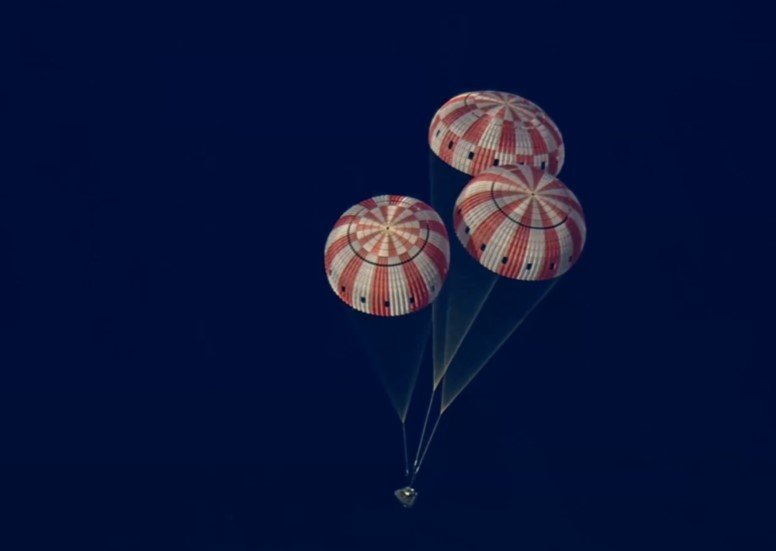
Washington DC, April 11, 2026 — The NASA has successfully completed the Artemis II mission. The crew safely splashed down in the Pacific Ocean on Saturday. This event marks a major milestone in human space exploration.
Historic Return Signals New Space Era
After completing their journey around the Moon, the spacecraft re-entered Earth’s atmosphere. Soon after, it landed safely in the Pacific Ocean. The USS John P. Murtha (LPD-26) carried out recovery operations.
Meanwhile, NASA shared updates before reentry. The astronauts prepared the spacecraft, and weather conditions remained favorable. As a result, the landing went smoothly.
Record-Breaking Achievement in Space
Importantly, the crew traveled 252,756 miles (406,771 km) from Earth. This distance broke the previous record set by Apollo 13.
Therefore, Artemis II is now the farthest human spaceflight in history. This achievement highlights rapid progress in space technology.
Rare Solar Eclipse Witnessed
In addition to setting records, the crew observed a solar eclipse from space. This rare event added scientific and visual value to the mission.
Artemis II Crew Members
The mission included four astronauts:
- Reid Wiseman
- Victor Glover
- Christina Koch
- Jeremy Hansen
Notably, this is the first crewed lunar mission in over 50 years. Hence, it holds historical importance.
Mission Objectives Successfully Achieved
The Artemis II mission focused on several key goals. For example:
- Testing life-support systems
- Validating spacecraft performance
- Demonstrating emergency procedures
- Collecting critical mission data
As a result, NASA is now better prepared for future missions.
Global Recognition
Following the success, Ted Cruz praised the mission. He stated that the crew has inspired future generations. Moreover, the mission strengthens global interest in space exploration.
Overall, Artemis II is a major success. It brings humanity closer to returning to the Moon. Furthermore, it lays the foundation for future Mars missions.
In conclusion, this mission marks the beginning of a new era in deep space exploration.
About The Author