admin
admin 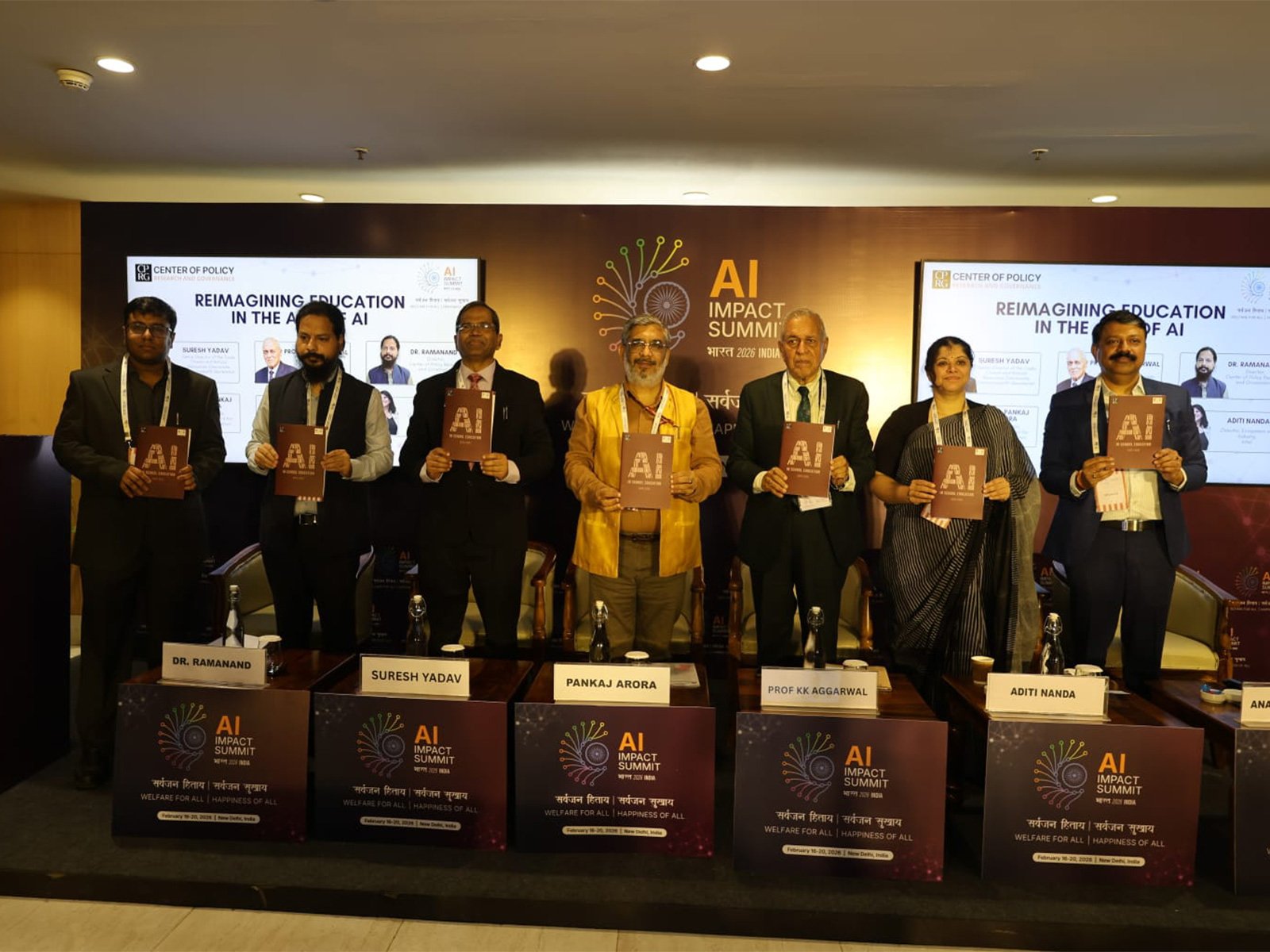
New Delhi, February 21, 2026:
The Centre of Policy Research and Governance (CPRG) hosted a major summit session titled “Reimagining Education in the Age of AI” at Sushma Swaraj Bhawan during the India AI Impact Summit 2026. The event focused on advancing Prime Minister Narendra Modi’s vision for the responsible and inclusive use of artificial intelligence (AI) in education.
AI to Transform Learning and Pedagogy
According to CPRG, the summit brought together policymakers, academicians, and industry experts. Participants discussed how AI can reshape learning systems, pedagogy, and institutional design. The panel emphasised the need to promote universal AI literacy among both learners and educators.
CPRG stated that the discussion reflected the broader priorities of the India AI Impact Summit 2026. The goal was to explore how technology can support equitable and personalised education models.
AI Should Assist, Not Replace Teachers
Dr Ramanand, Director of CPRG, highlighted the importance of balancing technology with human judgment. He said AI should enhance learning and assist teachers rather than replace them. He stressed that the focus must remain on the learning process, not just content delivery.
He also emphasised the need to make technology accessible across all regions and communities. According to him, equal access to AI tools will ensure inclusive growth in the education sector.
Dr Ramanand further called for reimagining future educational institutions. He said institutions must prepare to address technological challenges while ensuring ethical and responsible AI use.
Government and Academic Leaders Share Insights
S Anand Rao Patil, Additional Secretary of Higher Education, Government of India, underlined the importance of AI literacy among teachers. He said India has over one crore school teachers who must be equipped to guide students in using AI responsibly.
Prof KK Aggarwal, President of South Asian University, reflected on earlier technological transitions. He compared the current AI wave to the peak of the IT sector. However, he described the present AI transformation as even more significant.
Prof Pankaj Arora, Chairperson of the National Council for Teacher Education (NCTE), clarified that AI will not replace teachers. Instead, he said AI and teachers complement each other. He added that AI should function as an assistant that supports adaptability, creativity, and personalised learning.
Meanwhile, Suresh Yadav from the Commonwealth Secretariat described AI as a “360-degree transformation.” He said the key challenge is guiding this powerful shift in the right direction.
CPRG Launches Report on AI in School Education
During the summit, CPRG launched its latest report titled “AI in School Education.” The report presents findings on student engagement with AI tools. It also analyses the implications for curriculum design and classroom practices.
The event forms part of CPRG’s broader Future of Society initiative. This initiative studies the impact of emerging technologies on governance and public institutions.
Ahead of the India AI Impact Summit 2026, CPRG organised several pre-summit engagements across India and internationally. These discussions focused on AI governance, institutional readiness, and policy frameworks.
As part of its continued engagement, CPRG also hosted the second edition of its flagship PadhAI Conclave on AI in education. The conclave emphasised implementation strategies and institutional reform in the education sector.
The India AI Impact Summit 2026 continues to serve as a global platform for dialogue on responsible AI adoption, innovation policy, and technology-driven governance.
About The Author