
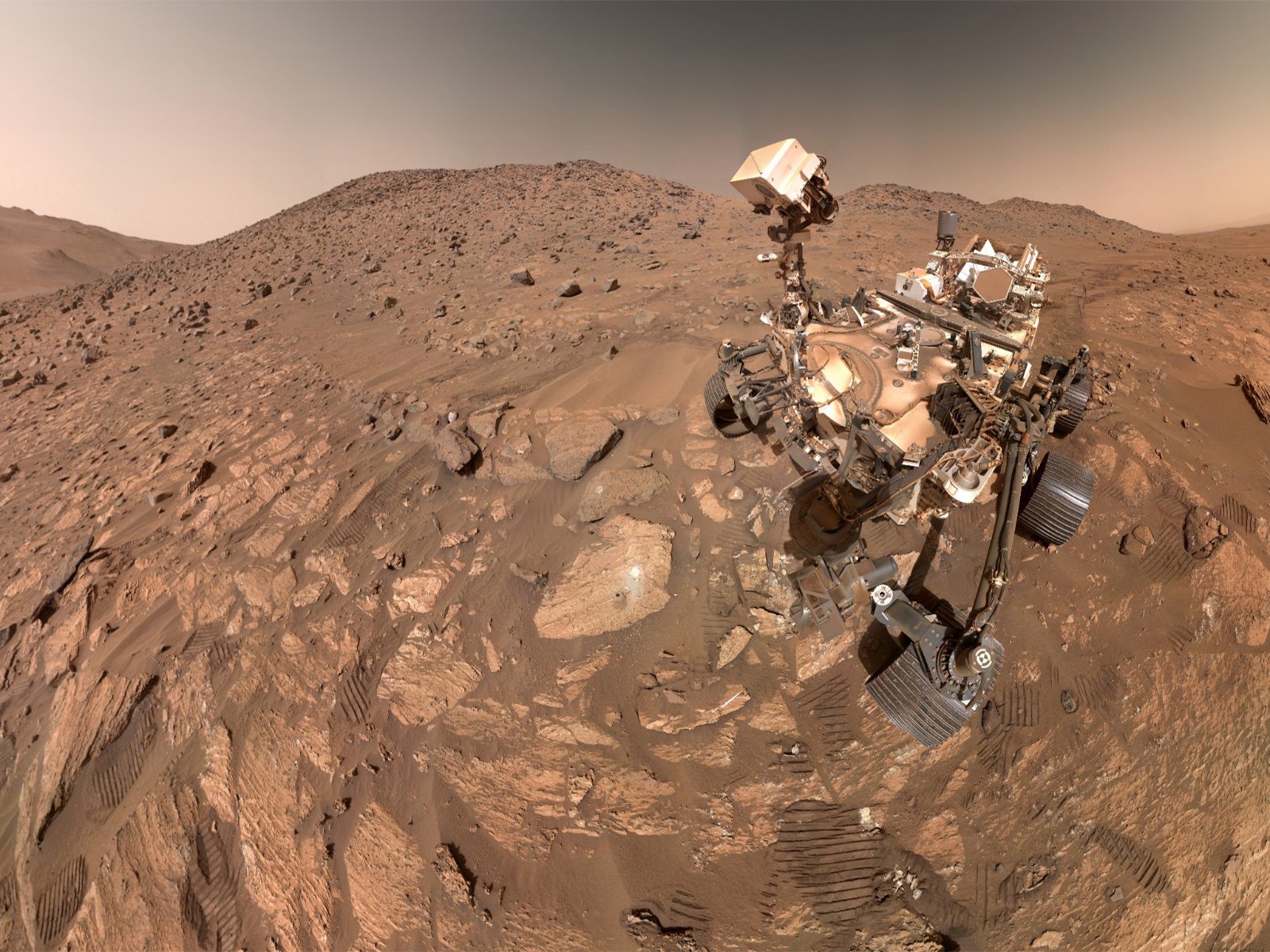
Signs of Life on Mars have become one of the most discussed topics in the scientific community after a groundbreaking new study revealed compelling evidence of ancient habitable conditions on the Red Planet. Scientists working with NASA’s Perseverance Rover have discovered minerals, organic compounds, and geological features that could represent some of the strongest indications yet that Mars may have once supported microbial life.
The findings, published in the prestigious journal Nature, have generated excitement worldwide as researchers continue to search for evidence of life beyond Earth.
Signs of Life on Mars Found in Jezero Crater
NASA’s Perseverance Rover has been exploring Jezero Crater since 2021. This 45-kilometer-wide crater was selected because scientists believe it once contained a large lake and river delta billions of years ago.
During its mission, the rover examined a unique rock formation known as the “Bright Angel” outcrop, located within an ancient river valley called Neretva Vallis. Scientists discovered a variety of minerals and organic materials preserved within these rocks.
These discoveries have strengthened the possibility of Signs of Life on Mars, as organic carbon and specific mineral formations are often associated with environments capable of supporting life.
How NASA Discovered Signs of Life on Mars
The Perseverance Rover used advanced scientific instruments including the Planetary Instrument for X-ray Lithochemistry (PIXL) and the Scanning Habitable Environments with Raman & Luminescence for Organics & Chemicals (SHERLOC).
These sophisticated tools allowed researchers to analyze the chemical composition of Martian rocks in unprecedented detail.
Scientists found silica-rich and clay-rich deposits within the Bright Angel formation. Such minerals are particularly important because they can preserve organic matter for billions of years. On Earth, similar geological environments often contain evidence of ancient microbial activity.
As a result, researchers believe these findings could represent potential Signs of Life on Mars from a distant past when the planet was much warmer and wetter than it is today.
Ancient Lake Environment Supports Signs of Life on Mars Theory
One of the most surprising discoveries was the identification of lake-bed deposits at the bottom of a river valley.
Normally, river valleys contain sediments deposited by fast-moving water. However, researchers found fine-grained mudstones and sedimentary structures that indicate a calm, low-energy lake environment.
This ancient lake would have provided stable conditions that are considered highly favorable for microbial life. Scientists believe the valley may have been flooded for an extended period, creating an environment where microorganisms could potentially survive and thrive.
The existence of such habitats adds significant support to the growing evidence of Signs of Life on Mars.
Why Scientists Are Excited About Signs of Life on Mars
Professor Sanjeev Gupta from Imperial College London described the discovery as a potentially significant biosignature.
A biosignature is any substance, object, or pattern that may indicate past or present life. While researchers are careful not to claim they have found definitive proof of life, the combination of organic carbon, sedimentary structures, and favorable environmental conditions makes this discovery particularly compelling.
Scientists emphasize that these Signs of Life on Mars must still be thoroughly investigated through laboratory analysis on Earth before any final conclusions can be reached.
Future Missions Could Confirm Signs of Life on Mars
NASA’s Perseverance Rover is currently collecting and storing rock samples for a future Mars Sample Return mission.
Once these samples are transported back to Earth, scientists will be able to use advanced laboratory equipment unavailable on Mars. This detailed analysis may finally determine whether the discovered organic materials were produced by biological processes or natural geological activity.
The upcoming sample-return mission is expected to play a crucial role in confirming whether these Signs of Life on Mars truly represent evidence of ancient extraterrestrial life.
Global Impact of the Signs of Life on Mars Discovery
The search for life beyond Earth is one of humanity’s greatest scientific pursuits. If future analysis confirms biological origins for these discoveries, it would represent one of the most important breakthroughs in human history.
Such a finding would not only transform our understanding of Mars but also raise profound questions about the possibility of life elsewhere in the universe.
The latest research provides a strong foundation for future exploration and reinforces the importance of continued investment in planetary science and space exploration.
The discovery of potential Signs of Life on Mars marks a major milestone in the exploration of the Red Planet. NASA’s Perseverance Rover has uncovered evidence of ancient lake environments, organic carbon, and mineral-rich deposits that suggest Mars may once have been capable of supporting life.
Although scientists have not yet confirmed the existence of ancient Martian organisms, the findings represent some of the strongest evidence ever discovered. As researchers await the return of Martian samples to Earth, the world watches closely for answers to one of humanity’s oldest questions: Are we alone in the universe?
Related Article:https://hindtalks.com/strongest-signs-of-life-on-mars-study/
Leave a Reply