

 admin
admin 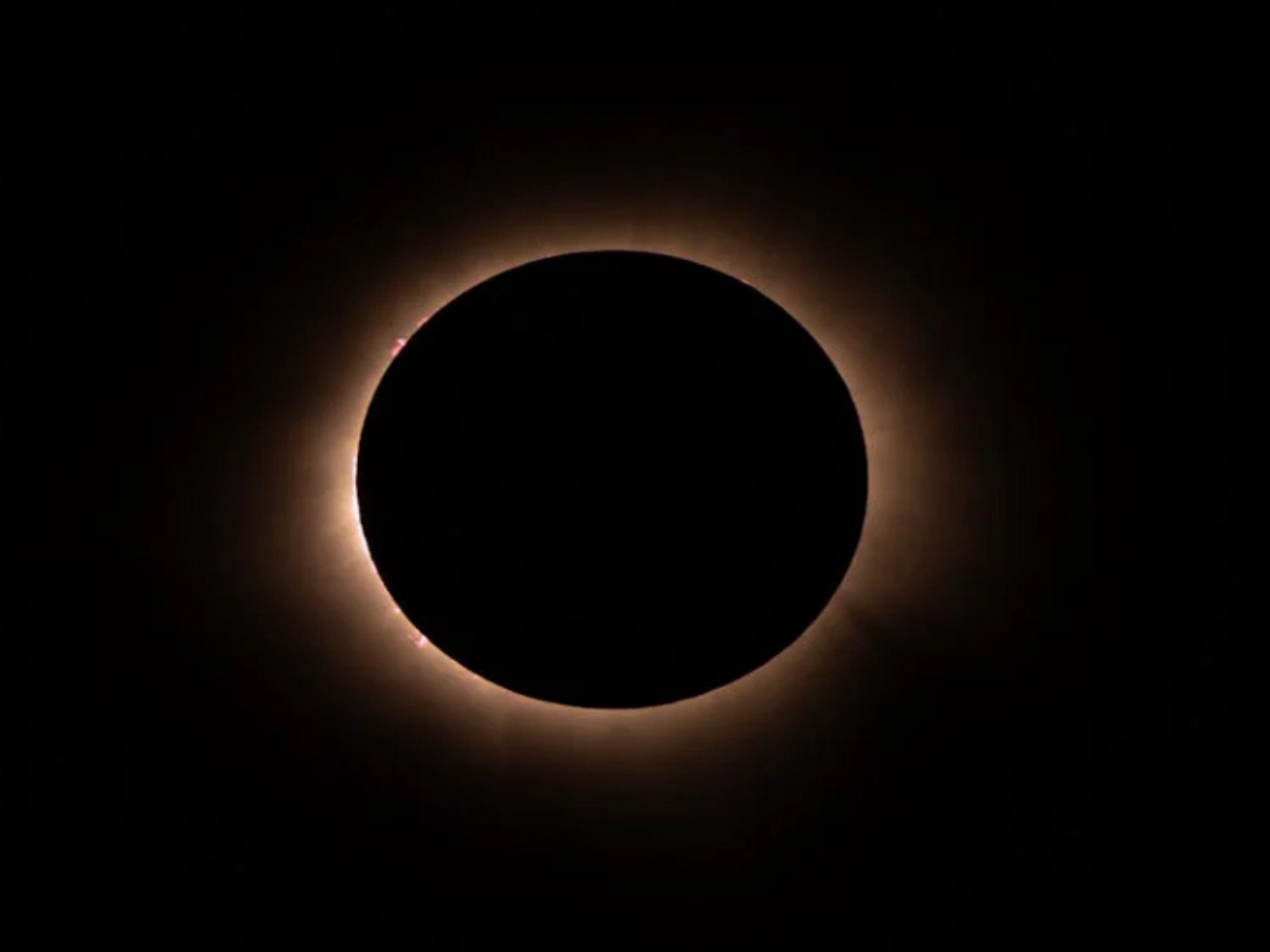
California [US], February 17: As the world experiences the first solar eclipse of 2026 today, entity[“company”,”Google”,”technology company”] has launched an interactive “Ring of Fire” animation on its search platform. This special feature allows users around the globe to witness the celestial phenomenon virtually, even if the eclipse isn’t visible from their location.
How Google’s ‘Ring of Fire’ Animation Works
image_group{“aspect_ratio”:”16:9″,”query”:[“Google Ring of Fire animation solar eclipse 2026″,”Google Search solar eclipse animation 2026″,”Google Ring of Fire eclipse graphic”,”Google Easter egg solar eclipse 2026″],”num_per_query”:1}
To trigger the animation, users simply need to search for terms like “solar eclipse,” “annular solar eclipse,” or “Surya Grahan” on Google. Once the search results appear, a dynamic graphic overlay shows the Moon passing in front of the Sun, mimicking today’s annular eclipse.
In an annular eclipse, the Moon appears slightly smaller than the Sun, leaving a bright ring—often called the “Ring of Fire”—around the Moon’s silhouette. Google’s animation highlights this striking effect, allowing users to feel part of the event, even from afar.
The 2026 Annular Solar Eclipse: What You Need to Know
Today’s eclipse is an annular solar eclipse, meaning the Moon is at a point in its orbit where it doesn’t completely cover the Sun. While a total eclipse would block the Sun entirely, leaving only a corona, an annular eclipse results in the “Ring of Fire,” where the Sun’s outer edge remains visible.
The eclipse began at approximately 3:26 PM IST and will end around 7:57 PM IST. Unfortunately, for viewers in India, the eclipse occurs when the Sun is below the horizon. The best viewing points are in Antarctica, southern Africa, and parts of South America.
Google’s Celestial Easter Egg Tradition
This interactive animation continues Google’s long-standing tradition of releasing special “Easter eggs” for major astronomical events. Over the years, the tech giant has celebrated solar eclipses, meteor showers, and planetary alignments with unique interactive features. These animations not only educate users but also spark curiosity about celestial phenomena.
By bringing the “Ring of Fire” directly onto search pages, Google ensures millions of users can enjoy the spectacle—whether or not they’re in the path of the eclipse.
The Science Behind the “Ring of Fire” Eclipse
An annular solar eclipse occurs when the Moon is at its apogee—its farthest point from Earth. Due to this distance, the Moon’s apparent size is smaller than the Sun, preventing it from completely covering the Sun’s disk. The result is a dazzling ring of sunlight around the Moon, hence the name “Ring of Fire.”
About The Author