
 admin
admin 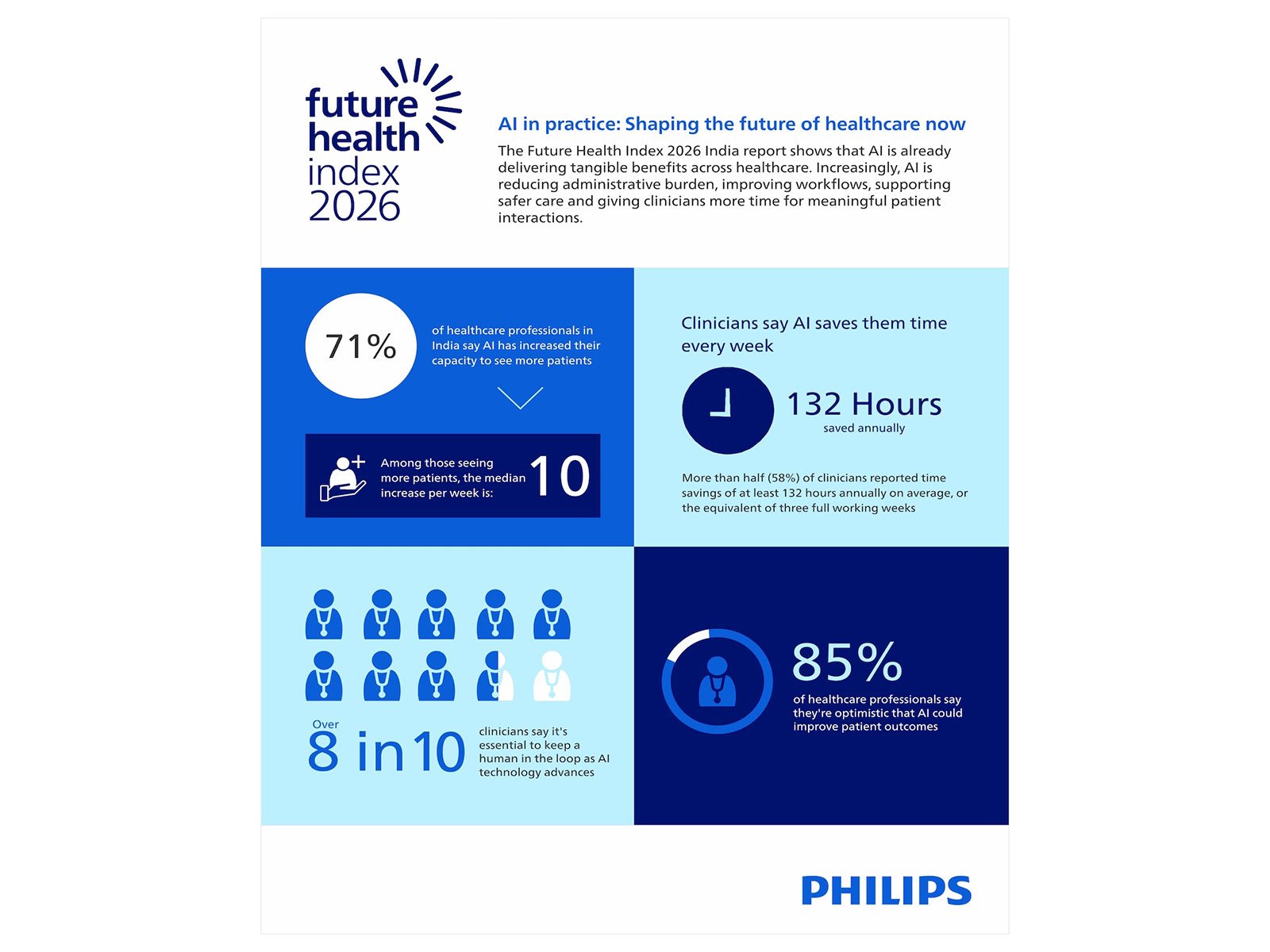
AI in healthcare in India is delivering measurable benefits across the country’s healthcare ecosystem, with healthcare professionals increasingly using artificial intelligence to improve efficiency, expand clinical capacity and support patient care, according to the India findings of the Philips Future Health Index 2026 report.
The global research surveyed more than 2,000 healthcare professionals and over 20,000 patients across 10 countries, including 200 healthcare professionals and 2,004 patients in India.
The findings indicate growing confidence in artificial intelligence among Indian healthcare professionals and patients. As AI in healthcare in India continues to expand, the report highlights its potential to improve clinical workflows while helping healthcare systems serve more patients with existing resources.
7 Key Findings About AI in Healthcare in India
1. 85% of Healthcare Professionals Are Optimistic About AI
One of the strongest findings from the report is the growing confidence in AI in healthcare in India.
According to Philips, 85% of healthcare professionals surveyed in India believe AI can improve patient outcomes. This represents an increase from 76% in the 2025 report.
The rise indicates that healthcare professionals are increasingly moving from simply exploring the potential of artificial intelligence towards recognising practical applications in clinical care.
The growing optimism also comes as healthcare systems face increasing demand and pressure to provide quality services efficiently.
2. AI Is Helping Doctors See More Patients
AI is also contributing to increased clinical capacity.
According to the Future Health Index 2026 India report, 71% of healthcare professionals said AI has increased their capacity to see more patients. This compares with 50% globally.
Among those reporting an increase in capacity, clinicians are seeing a median of 10 additional patients per week.
This is an important development for AI in healthcare in India, particularly as healthcare providers seek ways to improve access to medical services without proportionally increasing existing resource requirements.
3. AI Is Saving Valuable Working Hours
The report also highlights the time-saving benefits associated with artificial intelligence.
Philips said 58% of healthcare professionals in India reported average annual time savings of at least 132 hours through AI.
That is equivalent to more than three full working weeks.
These time savings could allow healthcare professionals to redirect some of their working hours towards patient interaction, clinical decision-making and other activities requiring human expertise.
The findings suggest that AI in healthcare in India is increasingly being viewed as a tool to support healthcare professionals rather than simply as a technology experiment.
4. AI Is Supporting More Meaningful Patient Interactions
Another important finding relates to communication between healthcare professionals and patients.
According to the report, 75% of healthcare professionals who save time using AI said the technology enables them to have more thorough interactions with patients.
The finding highlights a potential benefit beyond operational efficiency.
If administrative and repetitive tasks can be handled more efficiently, healthcare professionals may have more time available for conversations with patients.
This could make AI in healthcare in India an important part of efforts to create more patient-centred healthcare experiences.
AI Improves Workflow Efficiency
The Future Health Index 2026 India report also found that 82% of healthcare professionals reported improved workflow efficiency through AI.
Another 80% said AI had improved access to consolidated patient data across care teams.
Access to relevant patient information is important in healthcare because professionals may need to work with information collected across different departments or stages of treatment.
AI-enabled tools can potentially help organise and present information more efficiently, although clinical decisions still require appropriate professional oversight.
The findings demonstrate how AI in healthcare in India is increasingly being integrated into everyday healthcare workflows.
AI May Help Reduce Medical Errors
The report also points to AI’s potential role in supporting patient safety.
According to Philips, 48% of surveyed healthcare professionals said AI had helped them identify or prevent a potential medical error at least three times during the previous three months.
This finding suggests that healthcare professionals are already using AI-supported systems to identify potential issues.
However, the report also makes clear that human oversight remains essential.
As AI systems become more widely used, healthcare organisations need appropriate governance, training and processes to ensure that technology supports rather than replaces professional judgment.
AI Is Supporting Healthcare Professionals’ Well-Being
The benefits reported by healthcare professionals extend beyond clinical workflows.
According to the report:
- 71% said AI had improved their work-life balance.
- 69% reported reduced stress levels.
- 69% said they were doing less overtime or bringing less work home.
- 77% expect new roles to emerge as AI becomes more integrated into healthcare delivery.
These findings indicate that AI in healthcare in India could influence not only patient care but also the future working environment for healthcare professionals.
By reducing repetitive workloads and administrative pressure, AI could allow professionals to spend more time on tasks that require expertise, communication and human judgment.
AI Could Help Expand Access to Quality Care
Another major finding is related to healthcare accessibility.
The report found that 83% of healthcare professionals in India believe AI can help narrow quality gaps between different healthcare settings.
India has a diverse healthcare landscape, with differences in access to medical expertise, infrastructure and technology across regions.
AI-based healthcare tools could potentially help address some of these differences by supporting healthcare professionals and improving access to information and services.
However, effective implementation will require appropriate infrastructure, digital access, training and responsible governance.
Patients Are Also Embracing AI
The growing role of AI in healthcare in India is not limited to healthcare professionals.
According to Philips, 68% of patients surveyed in India said generative AI had helped them make the most of their time with their doctor.
This suggests that patients are also becoming increasingly comfortable with AI-enabled healthcare experiences.
The finding points towards a healthcare environment where AI could support both sides of the patient-care relationship.
At the same time, maintaining trust and ensuring that patients understand how AI is being used will remain important as adoption increases.
Responsible AI Adoption Remains Important
Despite the positive findings, the report also highlights challenges surrounding responsible AI adoption.
As AI becomes more deeply integrated into healthcare, professionals have identified the need for stronger training, technical support and governance.
The report found that:
- 86% of healthcare professionals believe all AI outputs require human oversight.
- 78% have had to correct AI-generated misinformation.
- 45% said AI training at their organisations is limited or inconsistent.
These findings highlight an important reality: the expansion of AI in healthcare in India must be accompanied by appropriate safeguards.
AI can support healthcare professionals, but its outputs need to be reviewed and interpreted within the appropriate clinical context.
India Has an Opportunity to Lead Responsible AI Adoption
Bharath Sesha, Managing Director, Philips Indian Subcontinent, said India is moving towards an AI-enabled future for healthcare and that the transformation is already underway.
He highlighted the finding that 71% of healthcare professionals reported increased capacity to care for more patients.
Sesha also noted that patients are participating in this transformation, with 68% saying generative AI has helped them make better use of their time with doctors.
According to him, the focus is increasingly shifting from AI’s potential to scaling its impact responsibly.
This could position AI in healthcare in India as an important part of the country’s broader digital healthcare transformation.
Future of AI in Indian Healthcare
The Philips Future Health Index 2026 findings suggest that artificial intelligence is moving beyond experimentation and becoming increasingly integrated into healthcare delivery.
From workflow efficiency and patient data access to clinical capacity and professional well-being, AI is showing potential across multiple areas.
However, responsible adoption will remain essential.
Healthcare organisations will need to invest in professional training, technical support and governance frameworks while ensuring that human oversight remains central to clinical decisions.
The success of AI in healthcare in India will therefore depend not only on technology but also on how effectively healthcare professionals, institutions and patients adapt to its growing role.
About The Author