
 admin
admin 
New Delhi | April 20, 2026
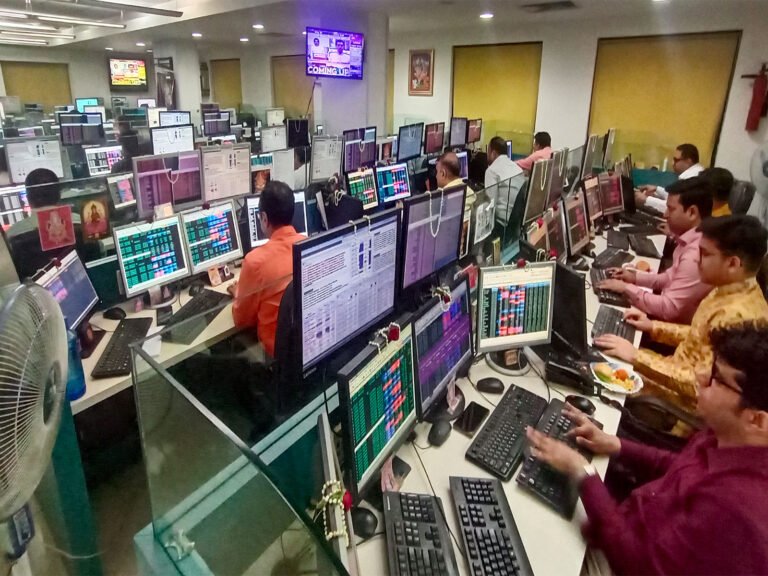
Indian equity markets opened on a cautious note on Monday. Investors reacted negatively to rising geopolitical uncertainty and a sharp surge in global oil prices. Concerns over the fragile US-Iran ceasefire weighed heavily on market sentiment, triggering early losses in benchmark indices.
At the opening bell, the BSE Sensex declined by 122.01 points (0.16%) to 78,371.53. Meanwhile, the Nifty 50 slipped 14.40 points (0.06%) to 24,339.15 at 9:15 AM.
Geopolitical Uncertainty Dampens Investor Confidence
Investor sentiment weakened primarily due to uncertainty surrounding US-Iran relations. Although a temporary ceasefire had initially boosted global markets, conflicting statements from both sides have created confusion.
As a result, investors are now adopting a cautious approach. Markets often react sharply to geopolitical risks, and the current situation has increased volatility across global financial systems.
Moreover, traders fear that any escalation in tensions could disrupt global trade and energy supplies. Therefore, many investors have reduced exposure to equities, especially in emerging markets like India.
Oil Price Surge Adds to Market Pressure
One of the biggest concerns impacting Indian equities is the sharp rise in crude oil prices. Global oil benchmarks surged amid fears of supply disruptions in the Middle East.
The price of Brent Crude jumped 4.72% to USD 94.65 per barrel. Similarly, WTI crude rose 5.51% to USD 88.47 per barrel.
This increase has significant implications for India, which imports a large portion of its oil. Higher crude prices typically lead to increased inflation, rising input costs, and pressure on corporate earnings.
Consequently, sectors such as aviation, logistics, and manufacturing may face short-term challenges.
Global Market Signals Remain Mixed
Global markets presented a mixed picture, further adding to investor uncertainty.
In the United States, futures trading showed weakness. Dow Jones Futures fell by 367.44 points (0.74%), reflecting cautious sentiment among global investors.
Meanwhile, gold prices saw a slight decline, trading at USD 4,807.93 per ounce. This suggests that investors are not fully shifting toward safe-haven assets yet.
However, Asian markets showed resilience. Japan’s Nikkei 225 rose 1.05%, while South Korea’s KOSPI gained 1.32%.
Similarly, Taiwan’s weighted index surged significantly, and Hong Kong’s Hang Seng Index recorded a moderate rise. China’s Shanghai Composite also moved higher.
On the other hand, Singapore’s Straits Times index remained slightly negative, indicating regional divergence in market performance.
Expert View: Markets in a ‘Wait and Watch’ Phase
Market experts believe that current conditions reflect a transitional phase. Ajay Bagga, a banking and market expert, described the situation as a “twilight zone” between optimism and uncertainty.
According to him, markets had previously rallied on hopes of a long-term peace agreement. However, investors now realize that verbal assurances are not the same as signed deals.
He explained that this pattern reflects a classic market behavior—“buy the rumor, wait for confirmation.” Therefore, traders are now closely watching geopolitical developments before making further moves.
Impact on Foreign Investment Flows
Rising geopolitical tensions and higher oil prices could affect foreign institutional investor (FII) activity. Experts warn that risk aversion may lead to reduced participation or even capital outflows.
Ponmudi R, CEO of Enrich Money, highlighted that uncertainty around the ceasefire has already weakened confidence. He added that rising crude prices have reversed earlier optimism in the market.
As a result, FIIs may adopt a cautious stance in the near term, which could limit market upside.
Technical Outlook: Support and Resistance Levels
Despite short-term volatility, technical indicators suggest that the broader trend remains positive.
Shrikant Chouhan, Head of Equity Research at Kotak Securities, noted that the market still holds a bullish structure on weekly charts. Additionally, daily charts show a higher bottom formation, which indicates underlying strength.
Key Levels to Watch:
- Support Zones: 24,100 / 23,800 (Nifty)
- Resistance Zones: 24,700 / 24,950 (Nifty)
For the Sensex, support lies around 77,800, while resistance levels are near 79,500–80,250.
Meanwhile, the Bank Nifty index continues to trade above key levels. As long as it stays above 55,800, the uptrend may continue. Analysts expect potential upside toward 57,300 and beyond.
Sectoral Impact of Current Trends
Different sectors may react differently to the current market environment:
- Oil & Gas: Likely to benefit from rising crude prices
- Aviation: May face pressure due to higher fuel costs
- Banking: Could remain stable but sensitive to global cues
- IT Sector: May see volatility due to global uncertainty
Therefore, investors should carefully evaluate sector-specific risks before making decisions.
Short-Term Outlook for Indian Markets
In the short term, Indian markets are expected to remain volatile. Geopolitical developments will continue to play a crucial role in shaping investor sentiment.
If the US-Iran situation stabilizes, markets may recover quickly. However, any escalation could trigger further downside.
At the same time, domestic factors such as inflation data, corporate earnings, and policy decisions will also influence market direction.
Indian equities started the week on a cautious note due to global uncertainties and rising oil prices. The fragile US-Iran ceasefire has created doubt among investors, leading to early market declines.
However, underlying technical indicators remain supportive. Therefore, the market may stabilize if geopolitical tensions ease.
For now, investors should adopt a balanced approach. Staying informed and focusing on long-term fundamentals will be key in navigating current market volatility.
About The Author