
 admin
admin 
The Bidadi land row has become a major political and social controversy in Karnataka after strong opposition emerged against the state government’s plan to acquire nearly 500 acres of agricultural land for the Greater Bengaluru Integrated Township (GBIT) project. The issue has triggered a heated debate between development plans and farmers’ rights.
The Bidadi land row is now drawing attention across the state as political leaders, farmers, and the government take opposing positions on the proposed land acquisition near Bengaluru.
Vijayendra Supports Farmers in Bidadi Land Row
Karnataka BJP President BY Vijayendra has strongly opposed the project, stating that farmers in the Bidadi region are unwilling to part with their agricultural land under any circumstances.
He emphasized that farmers are ready to “give up their lives but not their land,” highlighting the emotional and economic importance of agriculture in the region. His remarks have intensified the Bidadi land row, turning it into a major political issue in Karnataka.
Vijayendra also announced that BJP leaders would visit affected villages to meet farmers and understand their concerns, further strengthening opposition to the Bidadi land row.
Government Defends Township Project
The Karnataka government has defended the land acquisition, stating that the township project is essential for planned urban development and easing pressure on Bengaluru’s infrastructure.
Deputy Chief Minister DK Shivakumar clarified that the project is not new and is part of long-term urban planning. He said the government has followed legal procedures and that many landowners have already agreed to compensation.
Despite this, criticism continues, and the Bidadi land row remains a major point of disagreement between the ruling party and opposition leaders.
Opposition Criticizes Land Acquisition
Opposition leaders argue that the acquisition of fertile agricultural land for urban expansion is unfair and unnecessary. They claim that the Bidadi land row reflects a larger issue of rural land being taken away for development projects without adequate consultation.
Former Prime Minister HD Deve Gowda and Union Minister HD Kumaraswamy have also raised concerns over the project, questioning transparency and land acquisition methods.
Their involvement has added more political weight to the ongoing Bidadi land row.
Farmers at the Center of the Conflict
At the heart of the Bidadi land row are farmers who depend on agriculture for their livelihood. Many fear losing their ancestral land permanently and argue that compensation cannot replace fertile farmland.
They believe the township project threatens their economic stability and rural identity. This resistance has become a defining feature of the Bidadi land row, making it one of the most sensitive issues in the region.
Development vs Agriculture Debate
The Bidadi land row highlights the ongoing conflict between development and agriculture. While the government argues that infrastructure projects are necessary for economic growth and urban planning, farmers insist that agricultural land must be protected.
The debate continues to grow as Bengaluru expands rapidly into surrounding rural areas, increasing pressure on farmland and local communities.
The Bidadi land row remains unresolved as political tensions rise and farmers continue to oppose the township project. With strong statements from opposition leaders and firm responses from the government, the issue has become a major flashpoint in Karnataka politics.
The future of the project will depend on negotiations between stakeholders, but for now, the Bidadi land row continues to dominate public and political discussions in the state.
Bidadi Land Row: Karnataka Faces Major Clash Over Township Development and Farmers’ Rights
The Bidadi land row has emerged as one of the most debated political and developmental issues in Karnataka, following the state government’s decision to acquire nearly 500 acres of agricultural land for the proposed Greater Bengaluru Integrated Township (GBIT). The project, aimed at expanding urban infrastructure near Bengaluru, has triggered strong opposition from farmers and sharp political reactions from opposition parties.
As the dispute intensifies, the Bidadi land row has become a symbol of the ongoing conflict between rapid urbanization and rural livelihood protection in the state.
Vijayendra Intensifies Opposition to Land Acquisition
Karnataka BJP President BY Vijayendra has taken a firm stand against the project, openly supporting farmers who are resisting the acquisition of their land.
He stated that farmers in and around Bidadi are emotionally and economically attached to their agricultural land and are unwilling to part with it under any circumstances. According to him, the resistance reflects a broader sentiment across rural Karnataka, making the Bidadi land row a serious governance concern.
Vijayendra further claimed that BJP leaders would directly engage with affected farmers to understand their grievances and ensure their voices are heard in policy discussions.
State Government Defends Development Push
On the other hand, the Karnataka government has strongly defended the township project, calling it essential for managing Bengaluru’s rapid expansion.
Deputy Chief Minister DK Shivakumar stated that the GBIT project is part of a long-term development vision to reduce congestion in Bengaluru and create planned urban infrastructure. He emphasized that land acquisition is being carried out legally with proper compensation frameworks.
The government also argued that most landowners have agreed to the acquisition terms, although opposition claims continue to challenge this narrative, keeping the Bidadi land row highly controversial.
Farmers’ Protest Becomes Central Issue
Farmers in the Bidadi region remain at the heart of the Bidadi land row, expressing strong resistance to giving up fertile agricultural land.
Many farmers argue that their land is their only source of livelihood and cultural identity. They fear that once the land is acquired, they will lose not just income but also their traditional way of life.
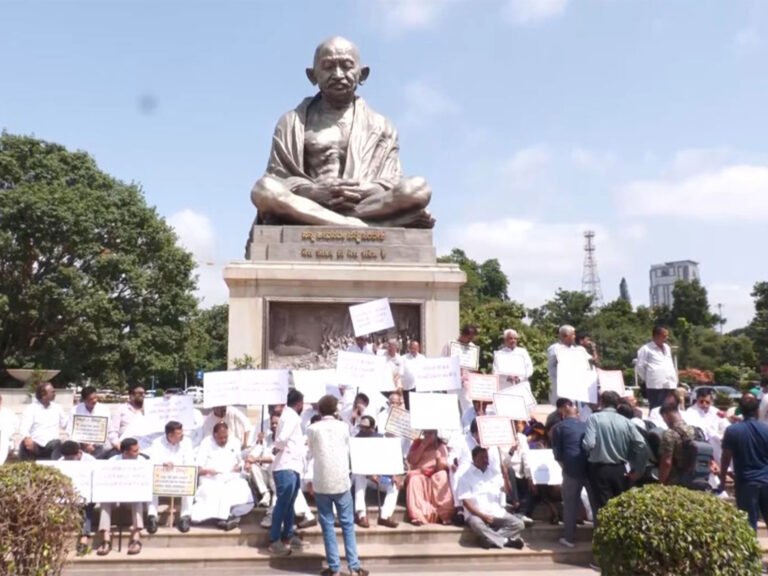
Local farming groups have organized meetings and protests, demanding transparency in the acquisition process and better protection of agricultural zones near Bengaluru.
Political War Between BJP and Congress
The Bidadi land row has quickly turned into a political battleground between the ruling Congress and opposition BJP in Karnataka.
While BJP leaders accuse the government of forcing land acquisition for corporate and infrastructure interests, Congress leaders argue that the opposition is trying to block essential development projects for political gain.
Chief Minister and Deputy Chief Minister have both maintained that the project is necessary for the state’s future growth, while opposition leaders continue to raise concerns over displacement and compensation.
This political confrontation has made the Bidadi land row one of the most high-profile issues in Karnataka’s current political landscape.
Concerns Over Compensation and Rehabilitation
One of the key issues in the Bidadi land row is the question of fair compensation and rehabilitation for affected farmers.
Farmers argue that monetary compensation cannot replace fertile agricultural land, especially in regions close to a rapidly expanding city like Bengaluru. They also fear long-term economic instability if they are forced to give up farming.
On the other hand, the government maintains that compensation packages are designed to be fair and legally compliant, but trust between stakeholders remains fragile.
Urban Expansion vs Agricultural Protection
The Bidadi land row highlights a growing challenge faced by many Indian states—balancing urban development with agricultural preservation.
Bengaluru’s expansion has increased demand for land around its outskirts, particularly in strategically located regions like Bidadi. While planners see this as an opportunity for economic growth and infrastructure development, farmers see it as a threat to their survival.
Experts believe that without proper consultation and sustainable planning, such conflicts may continue to grow in the future.
Opposition Leaders Raise National Attention
The issue has also drawn attention from senior political leaders, increasing its visibility beyond Karnataka.
Former Prime Minister HD Deve Gowda and Union Minister HD Kumaraswamy have both raised concerns regarding transparency and fairness in land acquisition.
Their involvement has further escalated the Bidadi land row, making it not just a state issue but also a politically sensitive national topic.
Future of the Bidadi Township Project
The future of the township project remains uncertain as discussions continue between the government, farmers, and opposition parties.
While the state insists that the project is crucial for infrastructure development, resistance from farmers and political opposition continues to slow progress.
Unless a consensus is reached, the Bidadi land row is likely to remain a major political and social issue in Karnataka for the foreseeable future.
Conclusion
The Bidadi land row reflects a deeper conflict between development ambitions and agricultural preservation. With strong opposition from farmers and political parties, and firm backing from the government, the issue has become a defining debate in Karnataka’s development story.
As negotiations and protests continue, the resolution of the Bidadi land row will play a crucial role in shaping the state’s approach to land acquisition and urban expansion in the coming years.
Farmers Protest Intensifies in Bidadi Region
The core of the Bidadi land row lies in strong resistance from farmers who depend on agriculture for their survival. Many farmers in the region have openly opposed giving up their fertile land, stating that compensation cannot replace their livelihood or ancestral property.
Local farming communities argue that the township project threatens their economic stability. They believe that once land is acquired, their agricultural identity and long-term income security will be permanently lost.
Protests and village-level meetings have intensified, with farmers demanding transparency, fair compensation, and complete withdrawal of forced acquisition plans.
Vijayendra Leads Political Opposition
Karnataka BJP President BY Vijayendra has emerged as a key political voice in the Bidadi land row, strongly opposing the state government’s decision.
He accused the government of ignoring farmer sentiments and claimed that people are ready to sacrifice everything except their land. His statements have added significant political pressure on the ruling administration.
Vijayendra also announced that BJP leaders will directly visit affected villages to stand with farmers and assess ground realities, further intensifying the Bidadi land row debate.
Karnataka Government Defends Development Project
The state government, led by Deputy Chief Minister DK Shivakumar, has strongly defended the township project, stating that it is part of a long-term strategy to decongest Bengaluru and promote planned urban expansion.
Officials argue that Bengaluru’s rapid growth demands satellite townships and infrastructure upgrades, which require land acquisition in surrounding regions like Bidadi.
The government maintains that legal procedures are being followed and that many landowners have already agreed to compensation packages. However, critics say this does not fully reflect ground reality, keeping the Bidadi land row highly sensitive.
Political Clash Between BJP and Congress Escalates
The Bidadi land row has now evolved into a full-scale political confrontation between the ruling Congress and opposition BJP.
While BJP leaders accuse the government of forceful land acquisition and alleged favoritism toward developers, Congress leaders argue that opposition parties are deliberately trying to block infrastructure development for political gain.
This ongoing political exchange has made the Bidadi land row one of the most heated issues in Karnataka’s current political landscape.
Concerns Over Land Acquisition Transparency
One of the major issues fueling the Bidadi land row is the lack of trust between farmers and authorities regarding transparency in land acquisition.
Farmers demand clear documentation, fair market valuation, and assurance that no coercion is involved. They also want rehabilitation support for long-term livelihood security.
On the other hand, the government insists that acquisition policies are compliant with legal frameworks and aimed at balanced development.
Urban Expansion Pressure Around Bengaluru
Bengaluru’s rapid expansion has significantly increased demand for surrounding land, especially in regions like Bidadi, which is strategically located for infrastructure development.
Urban planners argue that satellite townships like GBIT are necessary to reduce congestion in the city and distribute population growth more efficiently.
However, critics warn that unchecked urban expansion could permanently reduce agricultural land availability, making the Bidadi land row a long-term governance challenge.
Opposition Leaders Raise Serious Questions
The issue has also attracted attention from senior political leaders, adding more weight to the controversy.
Former Prime Minister HD Deve Gowda and Union Minister HD Kumaraswamy have raised concerns regarding transparency, land acquisition policies, and alleged misuse of authority.
Their involvement has pushed the Bidadi land row beyond state-level politics, turning it into a nationally discussed issue.
Development vs Livelihood Debate Deepens
At its core, the Bidadi land row represents a larger national debate — balancing economic development with agricultural preservation.
Supporters of the township argue that infrastructure growth is essential for Karnataka’s future. Opponents argue that agricultural land is irreplaceable and must be protected at all costs.
This conflict between development and livelihood continues to fuel tensions across rural and urban stakeholders.
Future of Bidadi Township Project Uncertain
The future of the township project remains uncertain as discussions between farmers, political leaders, and government officials continue.
Unless a mutual agreement is reached, the Bidadi land row is expected to remain a major political and social flashpoint in Karnataka.
Stakeholders now face the challenge of finding a balanced solution that supports both infrastructure development and farmer welfare.
Conclusion
The Bidadi land row has become a defining issue in Karnataka’s development politics. With strong opposition from farmers, sharp political exchanges, and firm government backing for the township project, the controversy shows no signs of ending soon.
The resolution of the Bidadi land row will likely shape future land acquisition policies and set an important precedent for balancing development and agriculture in India.
You’ve reached the Free limit for chats with attachments
Upgrade now or wait until tomorrow at 10:21 AM to keep using files, or chat now without files.
New chat
Upgrade
About The Author